




 nueva página del texto (beta)
 Inglés (pdf)
 Artículo en XML
 Referencias del artículo
 Traducción automática
 Enviar artículo por email
 Citado por SciELO
  Similares en
SciELO
Similares en
SciELO 
 Permalink
Introduction
The availability of an administrative and financial model within any business activity is of vital importance because it helps its permanence in the market. The case of Community Based Tourism Centers (CBTC) in Ecuador is no exception. Therefore, the objective of this research is to present a proposal of administrative and financial software for CBTCs. Since these companies do not have adequate business management models that facilitate the proper administration of their resources (economic, financial, and human talent). In addition, the proposal developed is based on a previous study where a diagnosis of the administrative and financial situation of 28 CBTCs in the provinces of Imbabura, Pichincha and Napo in Ecuador was carried out. With these results, the necessary elements for the adequate design of the software were obtained. Making this an original software that seeks to help these community centers in their administrative processes.
Literature review
Community-based tourism (CBT) is an alternative tourism that helps local communities to improve their economy by generating local employment (López-Guzmán et al., 2011). However, it should be considered as a complementary activity to primary activities within the communities, such as agriculture, livestock, and fishing. CBT is very important part of the country's tourism development, as it seeks local development through the inclusion of communities (Flores et al., 2016).
Jaramillo Moreno (2021) defined CBT as a management model leaded by a community assembly which aims the economic and social benefit of all its members without forgetting the care and protection of the natural and cultural resources of their localities and establishing different types of enterprises, according to the strengths and specific conditions of each community.
Within the sector of tourism, there are non-profit organizations which have established certain objectives for the management of sustainable destinations such as “maximizing economic and social benefits for communities and minimizing impacts” (Global Sustainable Tourism Council, 2013). Within these criteria, certain elements of the administrative process have been considered such as the organizational management of destinations, monitoring, planning, promotion, and visitor satisfaction, among others (Global Sustainable Tourism Council, 2013). However, all these have been implemented within the scope of a general perspective, without specifying the administrative or financial processes which are necessary for a good development and permanence of the enterprise.
Most community ventures have been developed under the support of international organizations of different type (Mtapuri & Giampiccoli, 2016) which have adapted traditional management models to a more local context (Zapata et al., 2011). However, the training provided to members of the venture are mainly aimed at gastronomy, guiding and foreign language programs, Though, these organizations continue to prepare better employees (Yanes et al., 2019), and not entrepreneurial leaders who can position the venture to compete in the tourism market.
An example of this statement is the CODEPSA Foundation, which developed a community-based rural tourism management model for the Andean Region. This model aimed to increase the income generated by tourism in order to improve the quality of life of the communities (Fundación CODESPA, 2011), under the guidelines of the development of a tourism product, with community organization and strategic alliances that help, mainly, to the commercialization of the stipulated product.
In other cases, the lack of interest in a specialized training by communities’ members (Tamir, 2015) leads to a poor management of the ventures which, finally, is reflected in the lack of satisfaction of the tourists who come to these places, as there is no follow-up of their satisfaction with the objective of improving the services offered. To obtain favorable results from tourist visits, it is necessary to improve both the infrastructure and the management of community resources (Teshome et al., 2020). On the other hand, training of all members regarding the duties and responsibilities within the enterprises should be considered and, also, that the hiring of personnel should be done based on their competencies and capabilities (Stone & Stone, 2011), which is currently neglected.
That is why, in a study by Dodds et al. (2018), it is stated that, in order to be successful in CBTs, it is important to take into account a clearly defined organizational structure, an adequate management of resources (economic, social and environmental), a collaborative work with external entities, the development of plans with clear objectives which , in the long term, can guarantee the benefit of all members of the community, the viability and the financial sustainability, by establishing marketing and collaboration agreements able to guarantee their access to the market. However, the administrative model to be established should be modified according to the circumstances and particularities of the communities (Bittar Rodrigues & Prideaux, 2018).
An administrative process cannot be based solely on the financial controls of the company, as Fayol already exposed in the 20th century. Nowadays, it is accepted the use of four fundamental management principles (see Figure 1): planning, implementation, monitoring and evaluation (Robbins & Coulter, 2014), the fulfillment of which leads to the achievement of the company’s objectives. Within these fundamental management principles, there are some specific processes which help to achieve these business purposes which lead to efficiently fulfill the operating cycle of organizations.
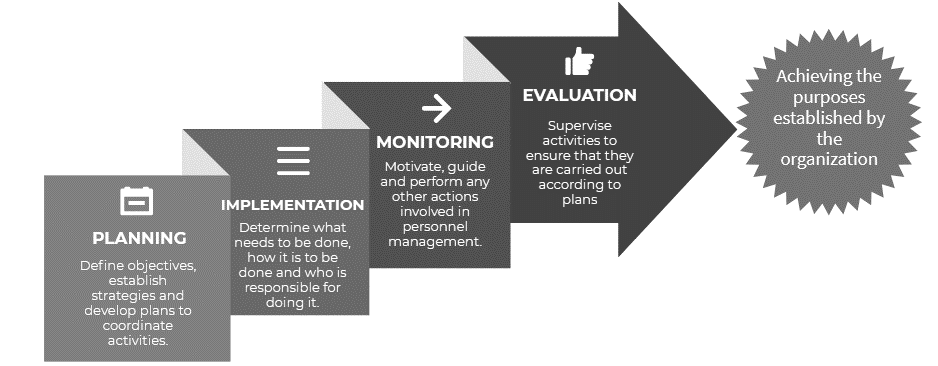
Similarly, within the community-based tourism enterprise, planning is very important when defining the objectives to be achieved and, therefore, the actions to be taken. Furthermore, for planning to work, it must be accompanied by an appropriate management and control (Cabin, 2016)which allow the community’s goals to be achieved in the tourism sector. According to Moyano Fuentes et al.(2011), if there are no clear objectives of what is to be achieved in a venture, the control and management of resources become more difficult.
So far, there are some proposals for a general management model for Community-Based Tourism Centers (hereinafter, CBTCs). Although some of these enterprises were developed by non-governmental organizations (NGOs), they do not have a complete community adaptation process. As a result, monitoring and control were insufficient when evaluating long-term results. Consequently, many CBTCs become extinct (or inactive(, which shows how important is to have an optimal organizational structure, as a key to success (Gajdošík et al., 2017), for any type of enterprise.
Another important element to be considered within the management processes of CBTCs is Information and Communication Technologies (ICTs). These technologies are important in the competitiveness of the tourism sector (Quiñonez-Bedón et al., 2019), because they facilitate the management of information inside (supplier) and outside (client) the venture. In other words, these technologies are not only used as a means of promotional dissemination of the ventures (López Rodríguez & López Rodríguez, 2018) but also facilitate the management of all processes.
ERP (Enterprise Resource Planning) is a system originated from the creation of MRP (Material Requirements Planning) systems, established by Joseph Orlicky in 1975 (Andonegi Martínez et al., 2005). These MPR systems were focused on planning the resources required for production, by reducing waste and optimizing time.
Since the creation of the MRP systems, other business management support systems have appeared, such as SCM (Supply Chain Management) for supply chain management, CRM (Customer Relationship Management) for customer relationship management (Andonegi Martínez et al., 2005) and TQM (Total Quality Management) (Cuesta Fernández, 2006). All of them are systems with particular objectives and are managed independently. SCM (Figure 2) is used for supply chain management, where the planned process goes from the purchase of raw materials to the sale of the final product, by reducing costs and times and satisfying customer needs(Cárdenas Eusse, 2016).

For its part, CRM is a customer management system that, since business success depends on customer satisfaction, turns the customer-supplier relationship into a fundamental element within the organization (Agudelo et al., 2013). That is why it aims to know, attract, and keep the customer in a long-term relationship (Figure 3).
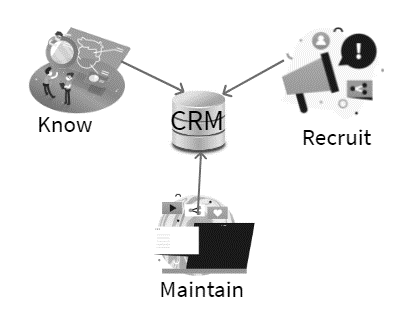
Finally, TQM is a Total Quality Management system based on the continuous improvement of business processes with the aim of achieving customer satisfaction (Cuatrecasas Arbós, 2011).
ERPs are systems that unify business processes in specialized software (Oltra Badenes, 2012). These management systems are characterized, according to Jara Saez & Neira Medina (2013), for being comprehensive (because they allow the control of all business processes(, modular (since they unify the different departments according to their processes( and adaptable to the particular needs of the ventures. In other words, information is centralized in databases so that all members and/or departments of the organization have access to them via local area networks (LAN) or the Internet.
One of the main advantages of using these systems is the easy and fast handling of information (Rivera Silva et al., 2018), creating greater interaction between all actors who are part of the business. Another important advantage is the decrease in costs and a better overall control of the established processes (Acosta Vega et al., 2017).
Among the main features of ERPs, we can highlight the use of a centralized database, the inclusion of different modules, the fact that its components interact with each other and that there is usually a software for each functional unit of the company (Jara Saez & Neira Medina, 2013). As shown in Figure 4, all departmental software (production, financial, inventory, sales, human resources and project management) are centralized in a database to which everyone may or may not have access, according to their job competencies.
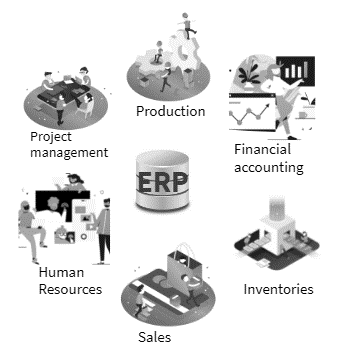
Source: Rivera Silva et al. (2018), Acosta Vega et al. (2017) and Jara Saez & Neira Medina (2013)
Figure 4 Enterprise Resource Planning ERP
The objective of this paper is to show administrative and financial software as an option to facilitate the CBTCs management.
Administrative and financial diagnosis in 28 community centers in Ecuador
In a diagnosis conducted by Jaramillo Moreno (2021) in 28 CBTCs in the provinces of Pichincha, Imbabura, and Napo in Ecuador, it was established that:
In the administrative phase of planning, it was established that the most used elements were: philosophy and values (25%), mission and vision (25%), objectives, strategies and policies (35.7%) and specific projects (35.7%); in the organizational phase, the outstanding elements were: registration within MINTUR (71.4%) or some government entity which legalizes the existence of the venture (78.6%), marketing plan (60.7%), definition of business processes (60.7%) and its management manual (60.7%), which go hand in hand with the determination of jobs (82.1%), recruitment processes (92.9%) and affiliation to the IESS (89.3%); in the management phase, there is decision-making (50%), motivational programs (53.6%) and promotional campaigns (53.6%); in the control phase, there is only quality control (71.4%). The remaining elements are poorly applied by the CBTCs, which suggests that their administrative management is deficient.
In the financial process, it was observed that the enterprises emphasize budgets (53.6%), income and expense records (60.7%), invoicing (60.7%) and tax records (67.9%), but not the entire financial process, which would help to better manage the economic resources of these enterprises.
By considering the four processes of general administration (planning, implementation, monitoring and evaluation), it is recommended that the administrative processes should be based on a planning of the activities of each CBTC, whilst the financial processes should be based on a specific chart of accounts for the activity developed by each venture. Also considering the importance of using new technologies as tools to maintain good control and information management (Rivera Silva et al., 2018), the development of an administrative and financial software for CBTCs that adapts to their needs and particularities is established as a proposal.
Materials and methods
Theoretical model construction
Following the results obtained in the diagnosis and in accordance with the four processes of general management, it is established that the administrative and financial model for these enterprises (Figure 5) should contain the following elements:
Administrative element: 1. It starts from a detailed planning of activities. 2. A responsible budget and timetable is established for each of these activities. 3. A follow-up of the fulfillment of the activities is made. And 4. Evaluation of the results, which are used for the continuous improvement of the enterprise.
Financial element: 1. Part of the creation of an accounting chart of accounts for the venture. 2. Continuous recording of economic transactions. And 3. Elaboration of the financial statements, used for the enterprise decision making.
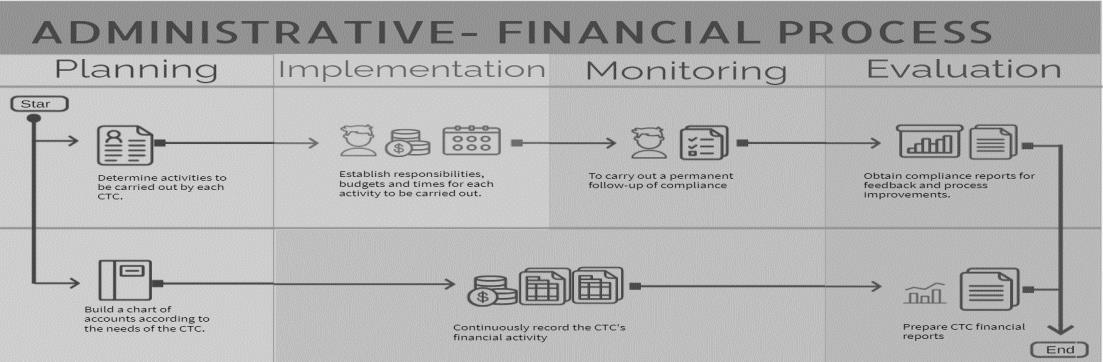
In addition, according to the needs of the community centers, two additional elements to those already established need to be implemented: Inventories, when the CBTC has a warehouse for the purchase and sale of products; and, finally, Inventories by consignment in the case that these ventures have this type of products sale. These are directly related to the financial element.
Model programming
PHP programming is an open-source scripting language that is accompanied by the use of a server. It can be used for programming many things, such as collecting information within forms, generating dynamic content pages, and can be used on all operating systems.
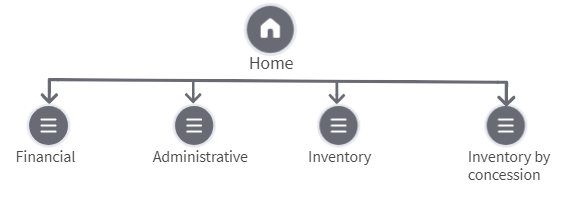
This software has been named SiAFcomunitario, Sistema Administrativo-financiero comunitario (Community Administrative-Financial System). It contains four sections, which are the elements established in the theoretical model (Financial, Administrative, Inventories and Inventories by consignment) (see Figure 6).
To start programming, XAMPP program, version 5.6.40 for Windows, which serves as a database manager (local server), was used. It is free and easy to use. In addition, it is compatible with all operating systems. For installation, the program was downloaded via the Chrome browser and the desired version and operator were chosen.
Once the server was installed, the database was created, containing the tables that store the desired information.
To create the database, Chrome was used, entering to localhost in the address bar, opening the XAMPP server. The necessary tables were created, the details of the database components and the number of tables created per section are shown in Table 1.
Table 1 Software design structure
| Sections | Tables | Dynamic content
pages |
Executable PHP
pages |
| Administrative | 4 | 12 | 13 |
| Financial | 2 | 11 | 7 |
| Inventory | 2 | 8 | 6 |
| Inventory by concession | 4 | 12 | 12 |
Source: Elaborated by the authors.
The dynamic content pages are those viewed by the user and are where the information related to any component of the system is entered, registered, and verified, in addition to the specific information search engines and general report generators.
They were designed and programmed with Adobe Dreamweaver CS6 and Notepad++ software, by using the PHP language. Table 1 shows the number of pages created, both with dynamic content and executable pages.
Software pilot in Oyacachi community
For the software design, it was necessary to run a pilot in a CBTC. For this reason, Oyacachy community center was selected considering that the diagnosis results obtained by this venture was 82/168, in other words, the administrative and financial processes were in a 48.81% of optimal development. This venture started in 1996 and is dedicated to the natural hot spring pools services.
The pilot was carried out at the beginning of 2020. A first version of the software was installed in the administrative and financial personnel devises, the staff was capacitated, and a manual was facilitated for the better use of it. After a period of two months, several meetings and all needs and considerations established, the final version of the software was designed.
Results
The main result of the administrative process is that the software should provide some freedom in the creation of the activities within the CBTC, considering that each community has a different reality and, therefore, they will depend on the tourism activity to which the venture is dedicated.
The principal result in the financial process is that the software must provide the same freedom as the activities to the accounting plan. It is important to emphasize that every venture undergoes changes and improvements within its development and, therefore, their activities as the accounting plan will also change, according to the needs of such evolution.
Other elements that were considered for the final design of the software were the technological advances and the involvement that the CBTCs must have in the ICTs; for this reason, the design can be used through the Internet and local area networks (LAN), allowing remote access by the personnel, using a local server or a Web server according to the facilities of the venture.
As explained in the methodology, the programming starts with the creation of tables which serve as databases. These communicate with the visualization pages (user interaction pages), where the user fills in the information that communicates with the executable pages which at the same time, feed the databases, creating the feeding cycle and operation of the software as shown in Figure 7.

The database tables, and the dynamic and executable pages were created according to the needs of each section of the software (financial, administrative, inventory and consignment inventories) (see Figure 8).
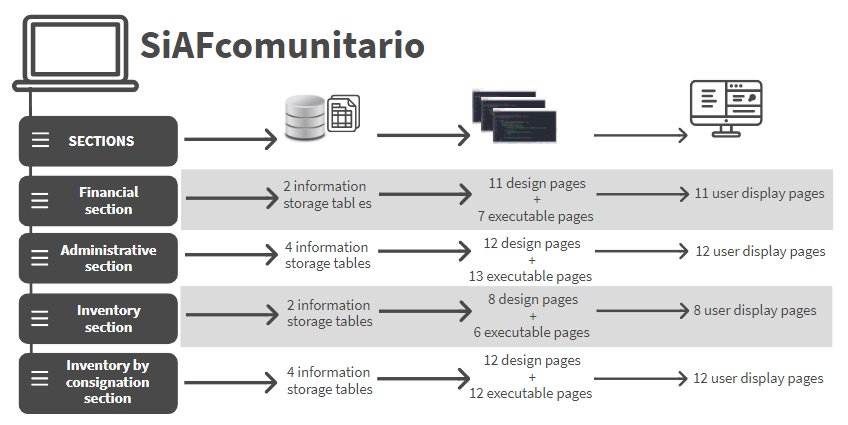
The financial section has 2 tables in the database, the first one recording the accounts chart and the second one the ledger. As for the user display pages, a total of 11 pages were designed with 7 executable pages. The administrative section has 4 tables (activities, contacts, follow-up and details). As user display pages, 12 pages were designed with 13 executable pages, which communicate the display pages with the database. For the inventory section, 2 tables were created (inventory and inventory movement). In addition, 8 and 6 display and executable pages respectively were designed. Finally, for the consignment inventory section, 4 tables were created: products, suppliers, incoming and outgoing goods, 12 user display pages and 12 executable pages were designed.
As can be seen in the Figure 9, the home page of the program is composed of the name of the program SiAFcomunitario, the name of the community, the menu with the four established sections and the copyright. Clicking on each section displays its menu where the user interaction pages are displayed.

In Figure 10, one can see the conformation of menus of the different sections. The financial section has: Chart of accounts, where the accounting accounts to be used in the enterprise are recorded; Ledger, where the economic transactions are registered; Majorization, where the movement of each one of the accounting accounts is seen; Final Situation Statement, where the financial situation of the company at the end of the accounting period is seen; Income Statement, where the economic profit or loss of the company at the end of the accounting period is established; accounting documents, the register of documents that will be used for the Declaration to the Internal Revenue Service of the country (SRI). Edit and delete section, where one can edit or delete both accounts and accounting entries; and, finally, Search, where one can search for a specific account on a given date.

The menu of the administrative section contains: Activities, where the activities planned in the project are recorded; Responsible persons, that is, the people who will carry out the established activities; Assignment of activities, where the person responsible for each activity is established, with the respective budget and schedule; General report, where the general information recorded can be viewed; Follow-up, where the percentage of compliance with the activities is recorded; Follow-up report, a general report on compliance with the activities; Edit and delete, where the activities and/or responsible persons can be changed or deleted; and, finally, Search, where an activity or responsible person can be searched for on a given date.
The inventory section has: Inventories, where the products for sale are registered; Inventory movement, where the entry and exit of merchandise is registered; Inventory report, where one can see the inventory movement report, inventory stock, and merchandise stock report; Profit, report that generates the profit generated by the sale of merchandise; and, finally, Edit and delete, where one can edit or delete a product from the inventory or any movement made.
Finally, the Consignment Inventory section contains: Suppliers, the people of the community who deliver their products under this consignment figure; Inventory, the products that enter the store of the enterprise; Product designation, in this page each product is assigned its supplier; Inventory movement, where the entry and exit of merchandise is recorded; Report, where the inventory, suppliers and product designation are detailed; Product stock, report where the merchandise stock is tracked; Profits, which is the report with the profit generated and the payment to be made to suppliers; and, finally, Edit and delete, forms where one can edit or delete products, suppliers and/or inventory movements.
All software display pages contain the name of the software, the name of the menu section to which it corresponds, button to return to the initial menu and the copyright.
Technical and economic feasibility of the software
It is important to clarify that this software can be used in two versions, online and offline. The technical requirements for the use of the two versions are basic and simple to obtain on any computer and considering that for the online version the CBTCs only need internet access, as shown in Table 2.
Table 2 Technical requirements offline and online versions
| Offline version | |
| Item | Description |
| Operating system | Windows vista and later/Linux/MacOS x10,6 and later |
| RAM | 256 MB |
| Memory space | 85 MB |
| Online version | |
| Operating system | Any computer or device with a web browser and internet access |
Source: Elaborated by the authors.
Regarding the economic feasibility of using the software, it should be considered that the annual costs to be budgeted by the CTBC are minimal. This is due to the fact that this software is free to use (no economic benefit is sought for its design and development). The costs that these ventures incur are mainly in the online version since they must have annual hosting and domain services. Table 3 shows the costs of the two versions. Internet is not taken as part of the costs since this is already a fixed cost in most of these enterprises.
Discussion
An accounting software where the economic transactions of the company are continuously recorded undoubtedly facilitates the control and analysis of the company's financial accounting information in real time. Thus, Rikhardsson & Yigitbasioglu (2018) already establishes in their study that the use of technologies in the administrative management of companies facilitates the collection and analysis of information. The financial section of this software contemplates the accounting element, which is indispensable for the planning and control of its financial and economic resources in a company. Also, it is an important tool for the management of business processes (Mite Albán, 2018) as well as for decision making (Rikhardsson & Yigitbasioglu, 2018). In addition, accounting is an element that provides the financial and economic reality of the company in the present and helps to consolidate the presence of the company in its future (Laguecir et al., 2020).
Planning in any organization is important because it defines the starting point for achieving its objectives. However, as stated by Phillips & Moutinho (2014), in tourism companies this important tool is not implemented. That is why, in this proposal, within the administrative section, the starting point is the establishment of activities to be carried out with their respective responsible parties, budget and schedule, to follow up and control the fulfillment of these activities and mainly the fulfillment of the objectives established by the CBTC.
Other important sections that were established in the software are inventories and inventories on consignment, since in the diagnosis carried out previously (Jaramillo Moreno, 2021) it was seen that community-based tourist centers have, as part of their enterprises, stores where they sell external and/or own products of the community, the first under the resale and the second under consignment with the artisans of the area. Keeping an inventory that controls the management of merchandise is essential in a business (Sridhar et al., 2021).
Conclusions
The proposal for this software is based on the need established in the diagnosis developed in 28 CBTCs in Ecuador. It was built on an administrative-financial model for Community Tourism Centers, based on the four processes of management administration (planning, implementation, monitoring and evaluation) and that these elements would be found within a software that would facilitate the management of the centers. This software contemplates that the administrative element must start from a list of activities; likewise, the financial process must start from the construction of the chart of accounts. All of these are specific to the venture particular needs.
A single software was developed with the four previously defined sections (administrative system, financial system, inventories, and inventories by consignment) that contemplate: the freedom of creation of the activities within the CTCs, respecting their particularities, and in the case of the accounting chart of accounts, responding to the activities of each enterprise.
Based on the results obtained in the pilot, a meeting was held to take into account all the observations made by the venture personnel in order to implement the pertinent adjustments to the software.
The final version was designed under the PHP programming language, considering the technological advances and the involvement that the CBTCs must have in ICTs. In addition, the need for freedom in the creation of the accounting accounts and the activities to be carried out within the ventures was established, due to the particularities that each CBTC may have.
The final software was called SiAFcomunitario (community administrative and financial system). For its development, the open access program XAMPP v5.6.40 was used, which fulfills the functions of a local server and where the databases were generated. This to facilitate its design and development. Adobe Dreamweaver CS6 was used to create the initial page of the Menu, and Notepad++ was used for the rest of the pages. In addition, a manual for the use of this software was developed.
The final design of the software contemplates the possibility of storing information on a local computer that is used as a server or also with the possibility of accessing web servers. All according to the facilities available to the CBTC.
This software is a tool that will help the community centers to follow up and, if necessary, make the respective corrections so that the administrative management of these ventures will be adequate.
Due to the adaptability of the software (freedom in the creation of activities and accounting plan), it can be used not only by community-based tourism centers but also by small ventures that want to have an adequate administrative and financial control.
Finally, this software is susceptible to changes and improvements that may be established over time and to technological changes that may occur.

